


Views: 0 Author: Site Editor Publish Time: 2026-06-10 Origin: Site


Standard High-Pressure Die Casting relies on high-velocity injection. Speeds often range from 10 to 50 meters per second. This extreme velocity inherently causes turbulent flow. Air becomes trapped inside the molten metal. Porosity forms within the solidifying walls as a result. For structural components requiring post-cast heat treatment or high mechanical integrity, this represents a critical failure point. You simply cannot afford hidden internal defects when manufacturing load-bearing parts.
The solution requires altering the fundamental physics of standard injection. It introduces laminar fill velocities, usually dropping below 0.5 meters per second. Engineers pair this slow filling stage alongside massive end-of-fill intensification pressure. Transitioning to this low-speed injection is not merely a machine setting adjustment on the factory floor. It requires a fundamentally re-engineered tooling approach.
This article breaks down the exact tooling requirements, thermal dynamics, and trial validation steps involved. We will explore how specific mold adaptations eliminate turbulence entirely. You will learn how to accurately evaluate supplier capabilities. Ultimately, you will understand how to secure high-integrity manufacturing for complex automotive and industrial components.
Standard HPDC molds will fail (due to premature metal solidification) if run at ultra-low speeds without advanced thermal regulation.
Success relies on specialized HPDC mold design, featuring optimized thick-gate layouts and precise thermal management to maintain metal fluidity during laminar filling.
Integrating a vacuum die casting mold infrastructure alongside low-speed filling virtually eliminates porosity, enabling structural aluminum alloy die casting capable of post-cast heat treatment (e.g., T6).
Validating the process requires rigorous mold trial production, utilizing Statistical Process Control (SPC) and X-ray inspection to map stability before mass production.
Standard casting processes utilize aggressive turbulence. The machine essentially sprays molten metal into the cavity at extreme velocities. In sharp contrast, the ultra low speed die casting process relies entirely on laminar flow. The plunger pushes the material gently. Speeds remain strictly controlled. The metal fills the cavity as a solid, cohesive front. This prevents the violent splashing responsible for air entrapment.
However, moving molten metal slowly creates a massive engineering hurdle. The steel cavity acts as a highly efficient heat sink. Molten material traversing slowly through this cold environment loses thermal energy rapidly. It will often lose heat faster than it can fill the available space. This temperature drop causes premature freezing. The metal solidifies before reaching the extremities of the part geometry.
Because of this severe solidification risk, standard thin-gate molds cannot be repurposed. They restrict fluid flow and aggressively strip heat from the incoming material. You must utilize a dedicated ultra-low speed die casting mold instead. Engineers design these specific tools to balance heat retention during the slow fill phase. The mold must maintain fluidity just long enough for the cavity to fill. Immediately afterward, it must withstand extreme high-pressure consolidation during the final squeeze phase.
Common Mistake: Attempting to run a low-speed profile on a legacy thin-gate tool. This inevitably causes severe cold shuts. The restricted gate freezes instantly, blocking intensification pressure from reaching the core of the casting.
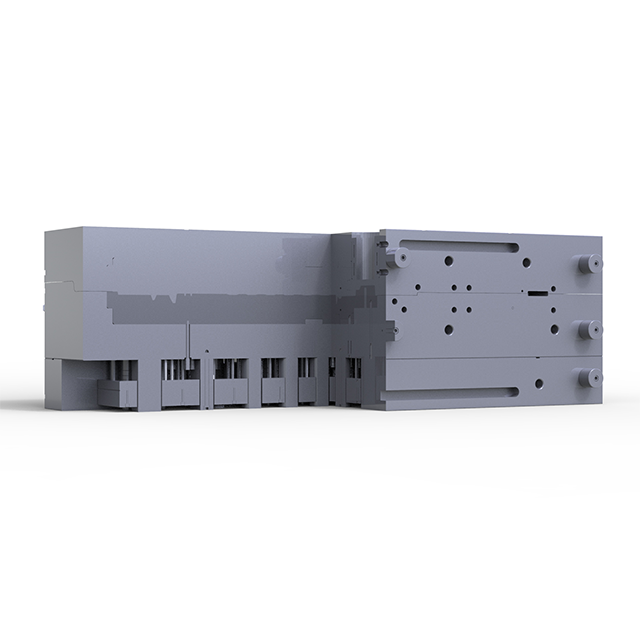
Engineers must evaluate tooling proposals based on very specific mechanical adaptations. A successful HPDC mold design tailored for low-velocity injection incorporates several mandatory features.
Traditional setups use exceptionally thin gates. This intentionally increases the metal velocity as it enters the cavity. Low-speed tools take the exact opposite approach. They require thick, expansive gating systems. A thick gate reduces fluid friction significantly. It allows the laminar flow to enter the cavity without accelerating into a turbulent spray.
More importantly, a thick gate prevents premature freezing at the entry point. The gate must remain partially molten after the cavity fills. This liquid pathway allows the machine to apply massive intensification pressure. The pressure transfers directly through the thick runner and into the core of the solidifying part. This high-pressure squeeze shrinks micro-porosity and densifies the final structure.
Standard operations rely heavily on active cooling to speed up cycle times. Laminar filling flips this requirement. Active mold heating becomes absolutely mandatory. Engineers cannot rely on cooling channels alone. They must map complex oil or pressurized water circuits throughout the steel block. These heating channels maintain exact cavity surface temperatures throughout the entire cycle.
Precise thermal mapping ensures the aluminum alloy die casting flows completely. The metal reaches the furthest edges of complex geometries without solidifying early. You avoid cold shuts and misruns entirely. The tool acts as an active thermal regulator rather than just a passive heat sink.
Slowly pushing material through thick gates alters thermal shrinkage dynamics. The metal solidifies differently. The internal stresses distribute differently across the part geometry. These changes demand specialized ejection pin placements. The force required to demold the part shifts, especially near the massive gating areas.
Engineers must adjust draft angles accordingly. Steeper draft angles prevent part distortion when the pins strike the casting. Smooth demolding protects the structural integrity of the hot aluminum. It also extends the lifespan of the tool itself.
Best Practice: Always conduct thermal flow simulations (such as Magma or Flow-3D) before cutting steel. Verify that the thick gate remains the very last section to solidify.
Reducing injection velocity solves only half of the defect equation. Slower speeds eliminate new air entrapment caused by turbulence. However, ambient air still occupies the empty cavity before the cycle begins. The incoming metal front pushes this ambient air forward.
You must give this trapped air an escape route. Pairing a low-speed gating layout with a high-efficiency vacuum die casting mold architecture creates the ultimate solution. A specialized vacuum system activates milliseconds before injection. It aggressively evacuates the cavity, bringing internal pressure below 50 millibars. This creates a near-perfect zero-entrapment environment.
When the laminar flow enters the vacuum-sealed cavity, it encounters zero resistance. No air pockets form. The final high-pressure consolidation densifies a purely metallic structure. This combined solution yields structural aluminum components completely free of gas porosity.
The outcomes for automotive and aerospace manufacturing are profound. This method produces fully weldable components. The parts can undergo rigorous T6 or T7 heat treatments without blistering. They compete directly with traditional Low-Pressure Die Casting (LPDC) parts regarding strength. Yet, they offer vastly superior dimensional tolerances and much faster cycle times.
Process Metric | Standard HPDC | Ultra-Low Speed + Vacuum | Low-Pressure (LPDC) |
|---|---|---|---|
Injection Velocity | 10 - 50 m/s | < 0.5 m/s | Extremely Slow (Rising fluid) |
Flow Dynamics | Turbulent Spray | Laminar Front | Laminar Front |
Gas Porosity Risk | High (Unavoidable) | Virtually Eliminated | Very Low |
Heat Treatment | Not Possible (Blistering) | T6 / T7 Compatible | T6 / T7 Compatible |
Cycle Time | Extremely Fast | Moderate (Highly Efficient) | Very Slow (1-3 Minutes) |
Theoretical tool designs mean nothing without rigorous real-world validation. Moving from CAD screens to stable manufacturing requires disciplined protocols.
You cannot validate complex tooling using visual inspection alone. Surface appearances hide internal flaws. Mold trial production demands strict data gathering from the very first shot. You must establish Statistical Process Control (SPC) immediately. Engineers map thermal data, intensification pressure curves, and cycle durations. They chart these metrics to prove process stability before approving mass production.
Industry data highlights one specific metric above all others. Biscuit thickness variations predict process stability perfectly. The biscuit represents the initial slug of metal left inside the shot sleeve. Minor dimensional deviations here correlate directly with internal porosity. A biscuit shrinking by just a few millimeters indicates fluid leakage or pressure drop. Control charting this thickness during trials reveals process drift instantly. It acts as an early warning system for internal part defects.
Buyers must mandate rigorous Non-Destructive Testing during the T0 and T1 trial phases. X-ray fluoroscopy scans reveal internal gas pockets. CT scanning maps material density in three dimensions. Inspectors focus heavily on the areas near thick-gate interfaces. They analyze complex geometric transitions. These areas represent the highest risk zones for shrinkage porosity. Only flawless X-ray results justify tool approval.
Verify cavity vacuum drops below 50 mbar before metal enters the gate.
Chart biscuit thickness across 100 consecutive shots to calculate standard deviation.
Perform X-ray analysis on 100% of parts produced during the T1 phase.
Cut and etch cross-sections of the thickest geometries to confirm microstructural density.
Commercial decision-making dictates that engineering benefits must justify capital expenditures. Specialized tools demand careful financial evaluation.
Advanced tooling requires a higher upfront CapEx than standard iterations. Complex heating channels, premium steel grades, and active vacuum sealing components drive up initial fabrication costs. You must acknowledge this reality when reviewing quotes. However, assessing these tools solely on their initial purchase price guarantees a flawed sourcing strategy.
You must calculate the overall manufacturing payback. Offset the initial premium against the drastic reduction in daily scrap rates. Eliminating internal porosity means parts pass X-ray inspections consistently. You also eliminate costly secondary impregnation processes entirely. Furthermore, this high-integrity method allows engineers to replace multi-part welded assemblies. You can cast them as single, unified structural components. Consolidating supply chains in this manner recovers tooling costs incredibly fast.
Buyers must audit prospective suppliers rigorously. Use this specific three-point evaluation criteria when reviewing partners:
Simulation Competency: Require proven capability in advanced thermal flow simulation using platforms like Magma or Flow-3D. They must prove their gating strategy works digitally first.
Vacuum Expertise: Demand evidence of in-house vacuum system integration. The partner must demonstrate how they maintain valve cleanliness and seal integrity during continuous operation.
Data Transparency: Ensure they provide transparent trial run data. They must share SPC charts, X-ray logs, and pressure curve readouts without hesitation.
The ultra-low speed methodology represents a highly specialized discipline. Machine parameters alone cannot guarantee success. The engineered tool dictates the final metallurgical outcome entirely. Standard approaches will inherently fail when subjected to laminar flow dynamics.
Investing in rigorous tooling design and comprehensive trial validation remains absolutely non-negotiable. You need thick gating, active thermal mapping, and integrated vacuum systems to produce high-integrity structural components. These elements work synergistically to eliminate porosity and enable advanced heat treatments.
Your immediate next step involves demanding data. Encourage your procurement teams to request process simulation data (DFM) from all prospective partners. Review their thermal mapping and flow predictions carefully before committing to any steel cutting. This proactive validation secures your investment and guarantees structural reliability.
A: Generally no. The gating thickness, runner design, and thermal management requirements differ fundamentally. Retrofitting a standard tool restricts fluid flow and disrupts the thermal balance. This approach almost always leads to severe cold shuts and unrecoverable scrap. You must build a dedicated tool engineered specifically for laminar fill dynamics.
A: Cycle times are slightly longer. This delay happens due to the slower injection phase and complex active thermal regulation. However, the times remain significantly faster than Gravity or Low-Pressure Die Casting (LPDC). It offers a highly efficient middle-ground for mass production.
A: While slow velocity prevents new air entrapment caused by splashing, the sealed cavity still contains ambient air. A vacuum system extracts this existing air completely. Evacuating the cavity below 50 millibars ensures the final high-pressure squeeze densifies the metal perfectly without creating internal gas voids.


