

Views: 0 Author: Site Editor Publish Time: 2026-09-17 Origin: Site


Procuring an automotive chassis casting mold represents a critical capital expenditure for any manufacturer. Tooling flaws at this early design stage do not just cost money. They compound exponentially during mass production runs. These flaws lead to unacceptable scrap rates and critical safety compliance failures. Balancing your upfront tooling costs against cycle times and mold longevity ultimately drives your operational profitability. You simply cannot afford to guess or take shortcuts during the procurement phase. This article provides a strict, evidence-based evaluation framework for bulk buyers. You will learn exactly how to audit tooling designs effectively. We will help you mitigate thermal fatigue risks before they ruin production runs. Finally, you will discover how to confidently shortlist qualified tooling partners for your next automotive project. By standardizing your technical demands, you protect your production lines from costly downtime. Read on to master the complete audit checklist.
Establishing clear performance baselines ensures long-term profitability. Procuring a mass production automotive chassis casting mold demands strict operational metrics. Volume-to-lifespan ratios dictate your true return on investment. You must establish realistic benchmarks early in the design phase. Lifespans typically range between 100,000 and 150,000 shots. The final number depends heavily on your tooling steel selection. Alloy aggressiveness also determines die erosion rates. High-silicon aluminum alloys act like sandpaper on cavity surfaces. They cause premature washout near gate areas. Magnesium requires different thermal controls due to rapid freezing characteristics.
Cycle time economics dominate high-volume casting operations. Every second shaved off ejection phases increases daily output. Cooling phases heavily impact per-part manufacturing costs. A five-year production run amplifies these marginal time savings. Shaving just three seconds per cycle yields massive financial gains over time. Shorter cycles also reduce energy consumption per cast part. Machine utilization rates improve significantly across your entire facility. You achieve higher output without buying additional die casting machines.
Scalability realities often disrupt initial production planning. Transitioning from prototype molds into scaled production introduces severe risks. Dimensional variations across multiple cavities happen frequently. Prototype dies often hide dangerous thermal imbalances. Scaling up requires rigorous thermal simulation software. You must account for uneven shrinkage across complex geometries. Cavity-to-cavity consistency ultimately defines your final mass production yield.
Auditing technical parameters separates durable tooling from failing dies. Assessing automotive chassis casting mold specifications guarantees component safety. Tooling material selection forms the foundation of die longevity. Evaluate premium hot-work tool steels rigorously. H13 and Dievar remain the standard for automotive structural parts. They withstand immense injection pressures effectively. Surface treatments like gas nitriding prevent premature surface wear. They also help the steel resist extreme thermal shock.
Thermal management directly controls final structural integrity. Cooling line design is a critical audit point. Conformal cooling outperforms traditional straight-line cooling methods. 3D-printed inserts allow water lines to follow complex contours. This strategy prevents hot spots in massive chassis components. It also minimizes severe warpage risks during final cooling.
Gating and venting dynamics control internal porosity levels. You must integrate active vacuum blocks correctly. Modern chill vents extract air milliseconds before the metal freezes. Optimized gating ensures smooth, turbulent-free metal flow. Strict automotive porosity limits demand flawless venting systems. Trapped air ruins the structural integrity of safety-critical nodes. It leads to blistering during secondary heat treatments.
Always perform a skeptical check on initial proposals. Reject quotes lacking certified metallurgical documentation. Suppliers must prove their raw steel quality unconditionally. They must also include moldflow simulation data upfront. A proposal missing simulation data is entirely incomplete.
| Tooling Material Grade | Primary Engineering Advantage | Thermal Shock Resistance | Typical Application |
|---|---|---|---|
| Premium Grade H13 | Excellent balance of toughness and hardness | High | Standard subframes and brackets |
| Dievar (Premium Steel) | Superior resistance to heat checking | Very High | Complex structural nodes |
| P20 Steel | Rapid machining capabilities | Low | Low-volume prototype runs |
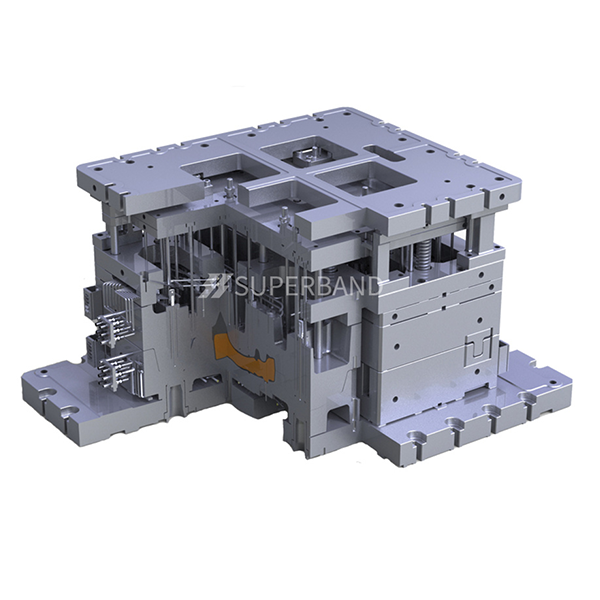
Electric vehicle architectures change structural casting requirements drastically. Evaluating a custom automotive chassis casting mold requires understanding these shifts. Battery trays demand exceptionally thin walls over vast areas. Structural shock towers require much larger surface areas. Traditional combustion subframes use thicker, simpler geometric designs. These modern changes heavily impact mold rigidity requirements. You need reinforced die blocks to prevent dangerous deflection. Deflection causes unacceptable flash around parting lines. Flash removal adds unnecessary secondary labor costs.
Modular mold designs offer distinct operational advantages. Evaluate replaceable inserts for all high-wear areas. Gates and runner blocks erode faster than main cavities. Replaceable inserts extend the lifespan of custom geometric features. They lower long-term preventative maintenance expenses significantly. You can swap damaged inserts without pulling the entire die. This keeps your die casting machines running smoothly.
Tolerance management becomes increasingly challenging on large EV parts. Set realistic expectations for initial shrinkage rates. Custom aluminum alloys shrink uniquely during rapid cooling. Magnesium alloys behave differently under high pressure. Emphasize the need for tight CNC machining tolerances. Both die halves must mate perfectly under locking tonnage. Precision CNC machining eliminates the risk of dimensional drift.
Transitioning into active production carries inherent process risks. Mitigate these risks before scheduling your T0 trials. The sample phasing process requires strict engineering discipline. Rushing this phase guarantees future scrap issues.
Define a rigid criteria loop for sample approval:
Predicting thermal fatigue saves substantial maintenance money. Address the reality of heat checking early. Surface cracking happens on every die eventually. Discuss scheduled maintenance intervals proactively. Establish stress-relieving schedules before mass production begins. Regular tempering extends overall die life significantly.
Acknowledge your scrap rate assumptions transparently. Initial scrap rates will fluctuate wildly during T1. Demand baseline capability index commitments early. Cpk targets of 1.33 must be met consistently. You need statistically stable production before final sign-off. Do not accept temporary process fixes from engineers. Adjusting machine parameters to mask bad tooling fails eventually. Permanent tooling corrections ensure long-term manufacturing stability. You must demand root-cause steel modifications during T1 and T2.
Finding the right engineering partner takes immense diligence. Selecting your automotive chassis casting mold supplier dictates project success. Certification verification is your absolute first filter. Look far beyond basic ISO 9001 compliance. Demand specific IATF 16949 automotive certification. Your partner must show experience building automotive structural components. Building simple consumer parts does not translate to chassis safety.
Prioritize strong in-house tooling maintenance capabilities. Outsourced mold repairs cause severe production delays. In-house repair teams eliminate downtime during critical bottlenecks. They fix surface heat checking issues immediately. Skilled technicians can polish die surfaces overnight. You avoid shipping heavy tools across the country.
Contractual and intellectual property protections remain vital. Ensure explicit contractual terms before paying initial deposits. Establish clear tooling ownership upfront. If you pay the tooling fee, you own the asset. Define routine maintenance responsibilities clearly in writing. Outline strict non-disclosure agreements for proprietary chassis designs. Protect your engineering investments aggressively.
Common supplier audit mistakes to avoid:
The final decision matrix relies on strict evaluation. You must verify engineering simulation proof first. Metallurgical quality of the tool steel comes second. Supplier lifecycle support forms the third pillar of success. Procuring reliable tooling requires evidence over promises. Actionable data beats generic supplier guarantees every time.
Your next step requires immediate technical action. Advise your engineering teams to request comprehensive documentation. Demand a thorough Design for Manufacturability report immediately. Request a detailed moldflow analysis as the first gating stage. Do this before issuing any purchase orders. Strict adherence to this framework guarantees production readiness.
A: Lead times typically range from 8 to 16 weeks. This timeline depends heavily on mold complexity and simulation iterations. Raw steel procurement also impacts delivery schedules. Large structural molds require extensive CNC machining hours. Always factor in an extra two weeks for T1 dimensional corrections.
A: Ownership depends entirely on your initial contract. Generally, if the buyer pays the tooling fee, they own the physical asset. You can pull it from the supplier's facility anytime. However, this requires explicit legal phrasing. Always draft strict ownership transfer clauses before production starts.
A: Minor maintenance happens every 10,000 to 20,000 shots. This includes basic cleaning and ejector pin replacement. Major maintenance occurs roughly every 50,000 shots. This involves stress-relieving heat treatments and insert replacements. The exact schedule varies based on alloy types and operational thermal stress.


