

Views: 0 Author: Site Editor Publish Time: 2026-07-31 Origin: Site


Manufacturing electric motor housings demands strict zero-defect tolerance. The mold tooling directly dictates the motor's NVH (Noise, Vibration, Harshness) performance. It also controls thermal efficiency and structural integrity throughout the vehicle's lifespan. Underspecifying these crucial parameters leads to high scrap rates. You will likely experience severe porosity and premature tool failure. Conversely, overspecifying drives up unnecessary capital expenditures. Engineering and procurement teams need an objective framework to navigate these choices. You must define precise requirements clearly. This allows you to assess tooling options accurately. You can then confidently select a highly qualified partner. This guide explores the core technical requirements for specialized tooling. It helps you navigate complex engineering decisions effectively. You will learn how to optimize cycle times securely. We will also cover proven strategies to maximize production yields.
When you define your electric motor housing mold specifications, you directly influence the final product. Every dimensional tolerance plays a crucial role in motor operation. The stator must fit perfectly inside the finished housing. Dimensional tolerances prevent destructive stator misalignment. We focus closely on concentricity and cylindricity here. If the mold lacks precision, the stator shifts slightly. This microscopic shift creates a severe electromagnetic imbalance during operation. Imbalance generates operational noise and intense vibrations. Tight geometric control in the mold eliminates this issue entirely. It reduces overall NVH levels dramatically. Engineering teams must prioritize these tolerances during the design phase.
The electric motor housing acts as a primary heat sink. It plays a massive role in ongoing heat dissipation. The mold must accurately form complex internal water jackets. It also shapes external cooling fins precisely. You must prevent core shift during the high-pressure injection phase. If the core shifts, wall thicknesses vary wildly. Thin walls crack easily under high thermal stress. Thick walls retain unwanted heat and degrade motor performance. Precision tooling ensures perfectly uniform walls across the housing. This uniformity guarantees optimal thermal dynamics in the field.
Different raw materials require completely different mold approaches. Aluminum die casting demands extreme thermal shock resistance. High-pressure molten aluminum causes rapid tool wear. High-performance engineered polymers react differently inside the cavity. They need distinct venting and cooling layouts. Tooling engineers must adapt the internal mold structure accordingly. Shrinkage rates vary heavily between aluminum alloys and polymers. The cavity dimensions must account for these specific shrinkage rates accurately. Failing to align the mold material with the injection material guarantees part failure.
You must match your project volume with strict SPI classifications. The Society of Plastics Industry (SPI) defines global tool life standards. Class 101 molds handle over one million cycles effortlessly. They require the absolute highest quality tool steel available. Class 103 molds serve lower volume production runs efficiently. They typically last under 500,000 cycles before requiring major overhauls. Choosing the wrong mold class wastes your capital budget. It also risks catastrophic tool failure mid-production. Always align your tooling investment with accurate production forecasts.
Aluminum die casting creates extremely harsh thermal environments. We evaluate premium hot-work tool steels very carefully. H13 tool steel dominates the industry for these specific applications. It offers excellent hot-tensile strength under immense pressure. Dievar is another premium steel option available today. It resists heat checking and soldering exceptionally well. You must also assess strict steel hardness requirements. Hardness is universally measured on the Rockwell scale (HRC). Abrasive injected materials require significantly higher HRC values. Cavity blocks usually need 46-50 HRC for maximum longevity.
Uncoated tool steel degrades quickly under continuous high pressure. Specifying advanced coatings enhances release properties significantly. PVD (Physical Vapor Deposition) adds a durable, slick layer. Nitriding diffuses nitrogen directly into the raw steel surface. This hardens the exterior while keeping the internal core tough. These surface treatments prevent molten aluminum from soldering to the cavity. They extend the overall tool life drastically. They also reduce the costly time spent polishing molds during routine maintenance.
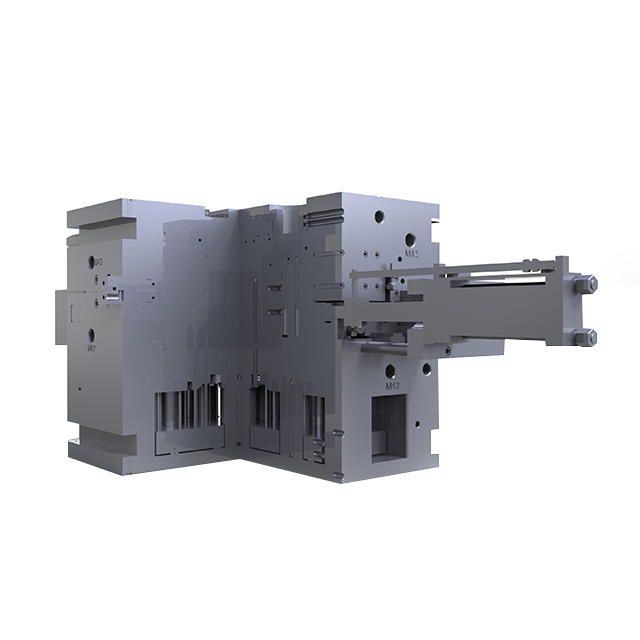
Building a robust ev components electric motor housing mold requires intense thermal engineering. Optimized cooling channel designs are absolutely critical here. Traditional straight-line cooling leaves dangerous hot spots inside the tool. Conformal cooling channels follow the part's exact geometric contour. They extract heat uniformly across highly complex geometries. Uniform heat extraction minimizes part distortion after ejection. It also shrinks overall cycle times significantly. This directly boosts your daily manufacturing output.
| Cooling Channel Type | Heat Extraction Uniformity | Cycle Time Reduction | Tooling Cost Impact |
|---|---|---|---|
| Traditional Straight-Line | Low to Medium (creates hot spots) | Baseline standard | Lower initial investment |
| Conformal Cooling (3D Printed Cores) | Very High (follows exact contours) | 15% to 30% reduction | Higher initial investment |
Geometric dimensioning and tolerancing (GD&T) establishes acceptable baselines. Critical features include main bearing bores and structural mounting flanges. We cannot compromise on these strict geometric tolerances. Tolerance stack-ups predict how minor variations affect the final assembly. Proper stack-up analysis prevents expensive downstream rework. It ensures the housing mates perfectly with the transmission block. Best practice dictates defining all critical datum structures before approving the mold design.
Standardizing draft specifications guarantees incredibly smooth part ejection. You cannot sacrifice the structural payload of the EV housing. Insufficient draft causes metal galling and part sticking. Too much draft ruins the internal dimensional requirements. Wall thickness transitions must remain very gradual. Sudden changes in thickness cause localized shrinkage and internal voids. Optimal wall thickness maintains structural integrity without adding unnecessary vehicle weight.
Creating a highly functional custom electric motor housing mold takes meticulous upfront planning. You must specify optimal gate locations early in the design phase. This ensures perfectly balanced fill rates during injection. Molten material must reach thick sections quickly and uniformly. Poor gating inevitably leads to dangerous cold shuts. It also creates weak weld lines in critical stress areas. Weld lines cause catastrophic field failures under torque. Advanced simulation software dictates exactly where we place the gates.
Trapped air remains a massive enemy in die casting. Air evacuation parameters actively eliminate destructive porosity. Porosity is a primary failure point in cast housings. High-pressure aluminum die-cast housings require aggressive venting strategies. Vacuum blocks pull air out rapidly before the metal injects. Chill vents freeze the molten metal safely to prevent flashing. You must specify exact vacuum levels to ensure pressure-tight water jackets.
Ejecting complex, hot housings risks severe structural deformation. You must customize the ejector pin layout carefully. This prevents part warping during the crucial ejection phase. Thin-walled geometries bend easily while still hot. Use larger diameter pins on internal ribs and thick bosses. Stripper plates offer uniform push force across flat perimeters. Ejection balance ensures the housing cools perfectly straight. Follow these sequential design steps to optimize mold engineering:
Finding a reliable electric motor housing mold supplier mitigates immense production risks. Buyers must demand upfront Moldflow or Design for Manufacturability (DFM) analysis. Do not cut any steel without running exhaustive thermal simulations first. A capable supplier identifies flow restrictions immediately. They recommend specific geometry changes to improve overall castability. Upfront validation prevents expensive tool modifications later. Always review their simulation reports with your internal engineering team.
Always check for stringent automotive-grade manufacturing certifications. IATF 16949 compliance is largely non-negotiable for EV components. ISO 9001 provides a basic baseline for quality management systems. You must also verify full material traceability of the tool steel. Counterfeit H13 steel will destroy your production timeline quickly. Demand official steel certificates directly from the original mills. Routine compliance audits ensure the supplier maintains these high standards year-round.
Structure your Factory Acceptance Test (FAT) rigorously before shipment. Require comprehensive CMM (Coordinate Measuring Machine) reports. Inspect the physical mold components meticulously against the 3D data. Evaluate the first-article inspection (FAI) parts against your original CAD requirements. The buy-off process must include pressure testing the cooling channels. Leaky water jackets inside the tool halt production instantly. Demand full dimensional layouts for at least three consecutive test shots.
The right mold specifications balance your upfront tooling investment perfectly. They ensure long-term production stability beautifully. Skimping on premium materials or engineering analysis creates massive downstream costs. You must prioritize suppliers who engage in heavy DFM upfront. They identify thermal and structural risks before final spec approval. Take action today to secure your production line. Consult with a specialized tooling engineer immediately. Submit your intricate CAD data for a preliminary DFM review. A highly precise electric motor housing mold guarantees better, quieter, and more efficient EV motors.
A: A custom mold typically requires an 8–14 week timeline. This window includes initial DFM analysis, raw steel procurement, CNC machining, and final assembly. Intricate designs with conformal cooling or complex sliders often push closer to the 14-week mark. T0 and T1 sampling trials are also factored into this comprehensive delivery schedule.
A: H13 tool steel offers exceptional hot-tensile strength. It withstands the extreme thermal fatigue inherent in high-pressure aluminum die casting. This steel resists heat checking, cracking, and soldering when exposed to rapidly fluctuating temperatures. Its durability ensures the mold can reliably meet long production runs without compromising dimensional accuracy.
A: Forming internal water jackets requires highly complex tooling mechanics. The mold must incorporate intricate slide mechanisms, specific core pulls, or even collapsible cores. These moving components must interlock perfectly to prevent the high-pressure molten metal from shifting the core. Any core shift ruins the wall thickness and destroys the jacket's integrity.
A: Suppliers must provide successful T0 and T1 sampling results. They should deliver comprehensive dimensional inspection (CMM) reports for both the tool and the cast parts. Additionally, they must conduct rigorous cooling system pressure tests to guarantee no internal leaks exist before final shipment.


