

Views: 0 Author: Site Editor Publish Time: 2026-04-01 Origin: Site


Die casting molds are precision-engineered tools at the heart of modern metal manufacturing, enabling the high-volume production of complex aluminum alloy components with exceptional accuracy and efficiency. Primarily used for non-ferrous metals like aluminum, zinc, and magnesium, these molds play a critical role in industries demanding lightweight, durable, and cost-effective parts—most notably automotive, electronics, aerospace, and consumer appliances.
At its core, the die casting process involves forcing molten metal into a reusable steel mold (die) under high pressure. The mold typically consists of two halves: a fixed cover die and an ejector die. Once closed and locked, molten aluminum alloy (heated to approximately 600–700°C) is injected into the cavity at speeds reaching 30–100 m/s. Rapid solidification follows, often within seconds, allowing the part to be ejected and the cycle repeated with minimal downtime.
This high-pressure injection distinguishes die casting from traditional gravity or sand casting. The process achieves tight tolerances (often ±0.05 mm), excellent surface finishes (Ra 0.8–3.2 µm), and the ability to form intricate features such as thin walls (as low as 0.5–1 mm), deep cavities, ribs, and undercuts—details that would be challenging or impossible with other methods.
Dimensional stability and repeatability: Consistent part quality across thousands or millions of cycles.
High material utilization: Minimal waste compared to machining or forging, with scrap easily recyclable.
Superior mechanical properties: Rapid cooling creates fine grain structures, enhancing strength, hardness, and corrosion resistance in aluminum alloys.
Cost efficiency at scale: Ideal for medium-to-high volume production, reducing per-part costs significantly after initial mold investment.
Design flexibility: Supports integrated features like bosses, holes, and threads, minimizing secondary machining operations.
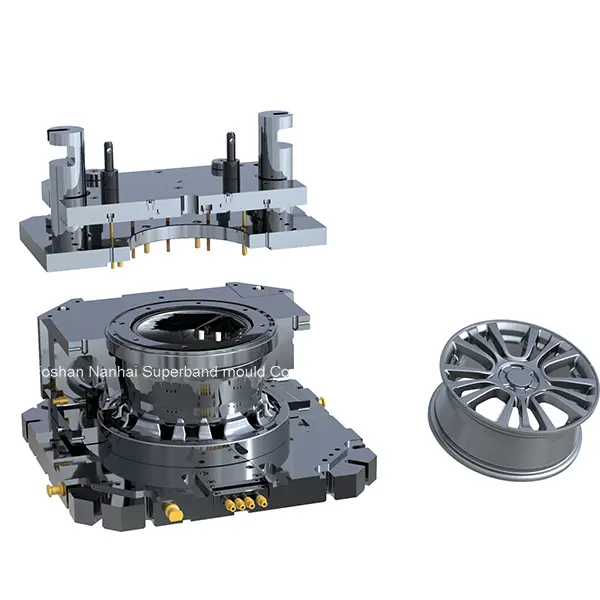
In practical applications, aluminum die casting molds excel in automotive lightweighting strategies. They produce structural components such as electric motor housings, battery enclosures, chassis subframes, steering knuckles, and suspension parts—helping manufacturers reduce vehicle weight by 20–40% while maintaining safety and performance standards. Beyond automotive, these molds support 5G communication equipment housings, LED lighting fixtures, medical device enclosures, and household appliance components where thermal management and aesthetics are essential.
As global demand for sustainable manufacturing grows, advancements in die casting mold technology—such as advanced cooling systems, real-time simulation software, and vacuum-assisted processes—continue to minimize porosity and improve part integrity. Understanding these fundamentals allows engineers and procurement teams to make informed decisions when specifying components for next-generation products.
For in-depth technical resources on aluminum die casting mold design and applications, explore Foshan Nanhai Superband Mould Co., Ltd.


