

Views: 0 Author: Site Editor Publish Time: 2026-05-09 Origin: Site


Porosity remains a persistent, frustrating challenge in modern manufacturing. Gas and shrinkage voids silently compromise structural integrity. They ruin leak-tightness and devastate overall yield rates. For decades, manufacturers relied on reactive fixes. They used costly vacuum impregnation to salvage defective units. You can now transition away from these expensive band-aids. Proactive, root-cause elimination is possible through advanced HPDC Mold design. This article serves as your comprehensive guide. We will help automotive engineers and procurement leads evaluate tool capabilities. You will understand the critical design features required for high-density components. Finally, we will show you how to calculate the true return on investment (ROI) of superior tooling. Stop accepting porosity as a natural byproduct. It is time to engineer it out entirely.
Root Cause Mitigation: Precision HPDC mold design targets the physical drivers of porosity—trapped air, 6-7% volumetric shrinkage, and thermal gradients.
Simulation is Mandatory: Predictive mold flow analysis (e.g., verifying gate freezing times against hot spot solidification) is a non-negotiable evaluation criterion for vendor shortlisting.
Vacuum HPDC Necessity: For structural automotive parts requiring T6 heat treatment or high weldability, Vacuum HPDC mold configurations are required to lower trapped gas to acceptable levels.
TCO over Unit Price: Upfront investments in conformal cooling, premium tool steel, and optimal gating significantly reduce long-term scrap rates and eliminate costly secondary salvaging operations.
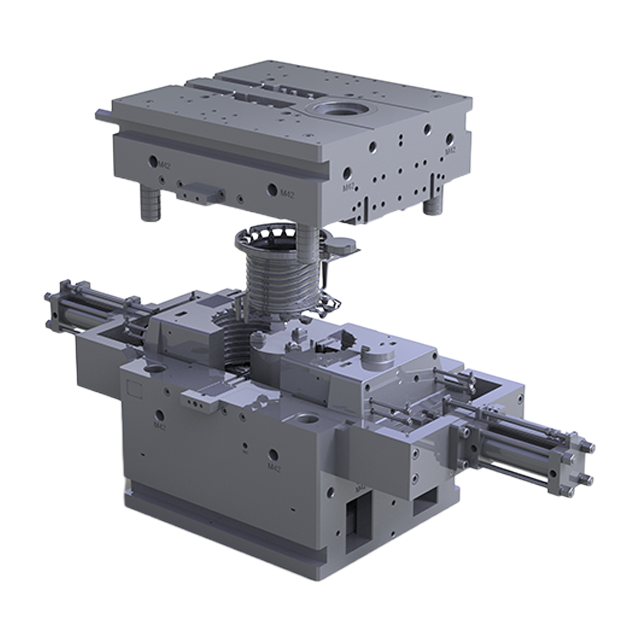
Basic definitions of porosity fall short when evaluating complex Automotive parts. You must frame this problem around production scalability, soaring scrap rates, and catastrophic end-use failures. Porosity does not merely look bad. It destroys mechanical function and inflates manufacturing costs exponentially.
Engineers categorize functional failures by the specific nature of the void. Understanding these distinctions helps teams identify the exact point of failure:
Through Porosity: These voids create continuous micro-channels from one surface to another. They cause critical fluid leaks in transmission housings and engine blocks. A single microscopic leak can trigger a complete fluid system failure under operational pressure.
Blind Porosity: These cavities open to the surface but do not penetrate entirely. They actively trap moisture and processing chemicals. This phenomenon leads to aggressive internal corrosion over time. You will often see severe blistering during surface finishing or anodizing stages.
Fully Enclosed Porosity: These hidden pockets severely compromise the mechanical load-bearing capacity of structural components. A-pillars and subframes lose their critical crash-resistance. Machinists often reveal these hidden voids unexpectedly during late-stage CNC machining. This wastes valuable processing time and tool life on a component destined for the scrap bin.
We must acknowledge the severe yield impact. Porosity historically causes 15% to 20% of all batch rejections in traditional foundries. Relegating these compromised parts to secondary salvaging is a terrible strategy. Vacuum impregnation acts as a costly, reactive band-aid. Impregnation seals leaks, but it never restores lost structural strength. It completely fails to solve the underlying mold inefficiencies causing the defects.
Modern tooling targets the physical realities of the casting environment. Precision engineering and rigorous process control are your best defenses against trapped gas and volumetric contraction.
Gating and Runner Optimization (Gas Porosity Prevention): You must design inner gates carefully. Proper geometry minimizes turbulence during the high-speed injection phase. We enforce strict overflow chute volume ratios. The overflow chute cross-section must remain under 60% of the gate cross-section. This ratio traps oxides and expels ambient air effectively. Furthermore, tool designers must align feed runner axes parallel to critical holes. This simple geometric rule prevents hot spots and mitigates directional turbulence.
Thermal Management & Conformal Cooling (Shrinkage Prevention): Molten aluminum naturally shrinks by 6% to 7% during solidification. We counteract this immense volumetric change by balancing conformal cooling channels. Precision placement ensures uniform temperature gradients across the entire part. We utilize high-conductivity inserts, like Beryllium Copper, in thick-walled hot spots. Beryllium copper transfers heat much faster than standard tool steel. This prevents the "time-gap fatal error." Imagine a scenario where the gate freezes prematurely at 5 seconds. Meanwhile, internal hot spots remain liquid at 18 seconds. This timeline blocks necessary pressure compensation, guaranteeing macroshrinkage.
Biscuit Thickness and SPC Control: The biscuit is not simply excess scrap. We utilize the biscuit as a vital pressure reservoir during the intensification phase. It acts as a buffer transferring force into the cavity. You must monitor the dimensional stability of the biscuit using Statistical Process Control (SPC). Variations in biscuit thickness serve as a predictive indicator. A remarkably thin biscuit warns operators of internal macroshrinkage long before X-ray inspection finds the defect.
High-compliance automotive components demand specialized solutions. Transitioning from traditional methods to vacuum-assisted systems provides a massive leap in part density.
Standard HPDC traps ambient air and lubricant gases inside the cavity. The ram injects metal at extreme speeds, atomizing the trapped air into microscopic bubbles. This makes standard cast components entirely unsuitable for high-temperature post-processing. Conversely, Vacuum HPDC evacuates the cavity prior to injection. The system aggressively pulls the internal pressure down to 50-80 mbar. This specialized equipment extracts up to 75% of the trapped air from the mold cavity.
Process Feature | Standard HPDC | Vacuum HPDC (VPDC) |
|---|---|---|
Air Extraction Method | Passive (relies on mold vents) | Active (pulls down to 50-80 mbar) |
Typical Porosity Risk | Moderate to High | Extremely Low |
Heat Treatment (T6) | Causes severe surface blistering | Fully compatible |
Structural Weldability | Poor (creates outgassing blowholes) | Excellent for BIW components |
Upgrading your Casting Process completely changes component performance. Standard die castings invariably blister during T6 heat treatment. The intense heat causes trapped gas pockets to expand violently against the softened aluminum. Vacuum molds enable T5 and T6 heat treatments safely. This thermal processing unlocks superior tensile strength and ductility.
Weldability also sees dramatic improvement. Advanced joining techniques require pristine, gas-free metal. VPDC is absolutely essential for structural body-in-white (BIW) parts. Chassis components also require high-integrity welding without outgassing risks. Furthermore, transitioning to closed-loop vacuum control delivers massive scrap reduction. It can demonstrably reduce scrap rates in highly complex parts. Gearbox housings historically suffer double-digit scrap rates. VPDC brings those costly failure rates down to low single digits.
Evaluating a tooling vendor requires strict logic. You must look far beyond basic machining capabilities. A reliable partner proves their competence digitally before cutting any physical steel.
Mandatory Simulation Capabilities: Look for partners who utilize advanced mold flow software. Demand visual proof during the quoting phase. Ask to see "50% liquid phase" thermal maps. These digital models must demonstrate cooling rates accurately. They must prove runner trajectories solve porosity issues completely. Do not accept guesswork.
Process Control & Monitoring Tolerances: Evaluate vendors directly on their real-time closed-loop control capabilities. High-quality tooling demands precise execution on the foundry floor. Ensure they can maintain tool temperature stability within ±5°C. They also need strict vacuum regulation and instantaneous shot speed modulation to guarantee consistency.
Tooling Material & Longevity: Assess their selection of premium tool steel. A top-tier mold often uses H13 steel enhanced with 5-10% Chromium. Surface treatments are equally critical for long-term stability. Demand coatings like CrN PVD or plasma nitriding. These advanced treatments resist brutal thermal fatigue. They prevent micro-cracking even after enduring 100,000 intense thermal cycles.
Procurement teams often focus entirely on the initial price tag. This approach causes massive long-term financial damage. You must understand the upfront versus lifecycle reality. Advanced molds carry a high initial capital expenditure (CapEx). Vacuum sealing mechanisms, intricate conformal cooling channels, and Beryllium copper inserts require expensive engineering.
However, the ROI drivers heavily favor premium tooling:
Drastic reduction in X-ray inspection failures: Reliable density eliminates costly sorting. You avoid quarantining questionable batches.
Elimination of secondary salvage costs: You no longer pay third-party vendors for constant vacuum impregnation.
Faster cycle times: Optimized thermal extraction solidifies parts faster. This dramatically increases your daily output.
Reduced tool wear: Balanced thermal stress minimizes maintenance downtime. A well-cooled mold runs longer without catastrophic cracking.
We offer a clear strategic recommendation. For high-volume production, you must look past unit price. Sourcing a marginally cheaper mold mathematically guarantees negative ROI over time. Poor thermal balancing and cheap gating designs guarantee sustained porosity scrap rates. You will pay for a cheap mold a thousand times over in rejected parts and delayed assemblies.
Porosity is never an inevitable byproduct of aluminum die casting. It is merely a symptom of inadequate mold engineering. It highlights poor thermal management and sloppy process control. We encourage buyers to move decisively beyond simple price-per-part discussions. You must audit potential manufacturing partners rigorously. Review their simulation data, scrutinize their cooling designs, and verify their vacuum capabilities.
Take proactive action today. Advise your engineering team to request a comprehensive DFM (Design for Manufacturing) review. Ask your vendor to run a predictive mold-flow simulation on your most problematic automotive component. Data-driven tooling upgrades will transform your production efficiency and eliminate structural defects permanently.
A: Yes, but only superficially. Manufacturers often use vacuum impregnation as a temporary sealant. This process injects specialized resin into the micro-voids to restore leak-tightness. However, impregnation is merely a reactive band-aid. It successfully seals fluid paths but cannot fix the underlying structural weakness caused by internal macroshrinkage.
A: Standard HPDC traps ambient air and vaporized lubricants inside the molten aluminum. When the final part undergoes high-temperature T6 heat treatment, these trapped gases expand violently. The rapid expansion pushes against the heat-softened aluminum surface. This causes severe, visible blistering and ruins the structural integrity of the component.
A: The biscuit acts as a critical pressure-transmission buffer during the final solidification phase. Molten aluminum shrinks significantly as it cools. A sufficiently thick biscuit provides a reservoir of liquid metal. The machine pushes this extra metal into the cavity under high pressure to fill shrinkage voids completely.
A: No. Non-structural components, like decorative brackets or simple covers, rarely require expensive vacuum technology. You should reserve Vacuum HPDC exclusively for critical parts. Use it when components demand maximum density, absolute pressure-tightness, crash-resistance, or high-integrity welding capabilities.


