

Views: 0 Author: Site Editor Publish Time: 2026-09-30 Origin: Site


Sourcing custom thermal management components creates a constant procurement tension for modern manufacturing facilities. You must constantly balance the upfront costs of holding custom inventory against the massive operational risks of prolonged press downtime. Planning your Minimum Order Quantity (MOQ) and lead times goes far beyond basic purchasing tasks. These numerical targets directly dictate your production ramp-up speed. They also determine the overall lifespan of your core tooling investment.
Production planners often struggle to align component arrival schedules. We aim to solve this disconnect by removing the guesswork from your supply chain strategy. This guide provides a realistic, evidence-based framework for calculating your exact volume requirements. You will learn how to accurately project delivery timelines when sourcing a reliable casting mold cooling system. By standardizing your procurement approach, you secure better component quality and guarantee consistent manufacturing uptime.
Delays in cooling system procurement stall the entire casting line. Production managers face a difficult daily balancing act regarding inventory levels. Over-ordering custom parts ties up critical working capital in stockrooms. Under-ordering risks catastrophic downtime if a single, highly specialized cooling channel fails during a heavy production run.
When buyers rush procurement to meet urgent deadlines, they often accept sub-optimal designs. Poor thermal regulation leads directly to rapid mold failure. You will begin to see soldering build up on the die surface. You will notice severe heat checking spreading across critical geometric features. These thermal fatigue defects cause excessive scrap rates and force toolmakers into emergency repair cycles. Manufacturers routinely lose thousands of dollars per hour during these unplanned press stoppages.
We recommend shifting your primary evaluation lens immediately. Move your focus away from the lowest price per individual unit. Start evaluating the total cost of production uptime instead. Spending slightly more capital on reliable, timely cooling components saves money long-term. You protect your expensive tooling investment. You guarantee consistent cycle times across multiple shifts.
Procurement teams must separate their purchasing strategies based on component complexity. Standard parts include O-rings, simple baffles, brass bubblers, and standard quick-disconnect fittings. These items carry high minimum order quantities. You often must buy 100 or more units in a single transaction. However, they carry a very low cost per unit. These standardized parts fit perfectly into bulk inventory strategies because they rarely become obsolete.
Custom parts demand an entirely different approach. These include specialized conformal cooling inserts and complex core pins. Suppliers typically offer low MOQs for these highly engineered items. You might order just one to five units at a time. They carry a significantly higher cost per unit. You should order these strictly based on projected maintenance schedules rather than bulk stocking strategies.
| Component Type | Typical MOQ | Cost Per Unit | Procurement Strategy | Risk of Obsolescence |
|---|---|---|---|---|
| Standard Baffles & Bubblers | 100+ units | Low | Bulk Inventory | Very Low |
| Standard O-Rings & Seals | 500+ units | Very Low | Bulk Inventory | Very Low |
| Custom Core Pins | 5 - 10 units | Medium | Scheduled Replacement | Medium |
| Conformal Cooling Inserts | 1 - 5 units | High | Just-In-Time / Kanban | High |
The manufacturing process you use directly dictates your inventory needs. A high pressure die casting mold requires intense thermal regulation. Violent thermal shocks cause rapid wear on internal components. You must replace specific inserts frequently to maintain acceptable part quality. We recommend planning a rolling MOQ for these setups. You can order fresh batches every single quarter. This active schedule ensures critical spares remain readily available on the shop floor.
Alternatively, a gravity aluminum auto wheel mold operates under entirely different mechanics. Slower cycle times produce significantly less thermal shock. Component life extends drastically under these gentler operating conditions. You can safely leverage lower MOQs here. Just-in-time ordering works perfectly. You simply need a manufacturing partner carrying verified backup stock.
We must warn you about a harsh implementation reality. Never order custom 3D-printed metal inserts in large volumes immediately. You must field-test a single prototype unit first. Validate the actual thermal performance on your press under real-world conditions. Only then should you commit to a larger volume order.
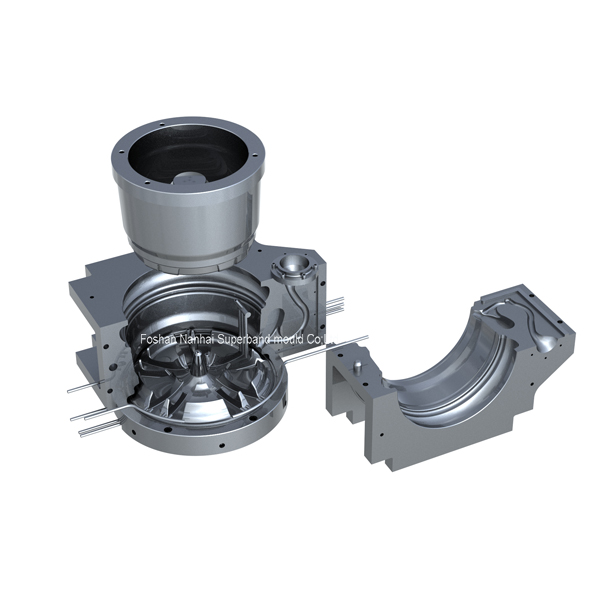
We need to provide a realistic, skeptical-friendly breakdown of where suppliers actually spend their time. Many buyers misunderstand the engineering steps required to produce safe, reliable thermal components.
Engineers must run computational fluid dynamics (CFD) before cutting any steel. Skipping this simulation to save time always leads to dead zones. Uneven cooling causes warped parts and compromised metallurgical structures. You cannot rush the fundamental physics of thermal transfer. Accurate simulation requires computational time and expert analysis.
You must differentiate between manufacturing methods here. Subtractive machining takes less time. Milling and drilling straight channels takes about two weeks depending on shop capacity. Additive manufacturing requires significantly more time. Direct Metal Laser Sintering (DMLS) builds complex conformal channels layer by layer from metal powder. This advanced printing process easily extends the timeline to five full weeks.
Quality assurance steps cannot be expedited under any circumstances. Metal parts require proper stress relieving in dedicated furnaces. Technicians must subject every internal channel to rigorous pressure testing for leaks. If you rush these steps, the inserts will crack under high injection pressures.
The trust factor plays a huge role in procurement. Treat extremely fast delivery promises with intense skepticism. Be wary of any vendor promising custom cooling layouts in under 10 days. They usually skip essential pressure validation to meet that deadline. They might bypass crucial heat treatments entirely. You end up paying for their shortcuts through premature tooling failure and compromised operator safety.
Your design choices heavily influence how fast parts arrive on your loading dock. Over-engineering your casting mold cooling system specifications unnecessarily extends lead times. Strict dimensional tolerances demand highly specialized machining centers. Complex internal geometries require custom inspection gauges. When you loosen non-critical tolerances, you speed up delivery significantly without sacrificing performance.
We strongly recommend adopting a firm standardization strategy. Design smart molds from the beginning. Aim to utilize 80% standard cooling components across your tooling portfolio. Limit custom inserts to only 20% of your total layout. This hybrid approach optimizes both MOQ burdens and lead times simultaneously. You get the immediate benefit of rapid standard part delivery. You still achieve highly targeted thermal control in the most critical tooling zones.
Your material selection choices also dictate your delivery schedule. Standard H13 tool steel remains widely available globally. Specifying exotic alloys improves thermal conductivity but complicates procurement. Specialized copper alloys and maraging steel pull heat away quickly from hot spots. However, these specialized metals routinely trigger global supply chain delays. Mills do not produce them in high volumes. You must factor material sourcing delays into your overall project timeline.
You must look closely at where the physical manufacturing work actually happens. A strong casting mold cooling system supplier controls the entire production process under one roof. They handle 3D printing, CNC machining, and thermal simulation in-house. Single-source control eliminates shipping delays between sub-contractors. It provides much shorter, highly reliable lead times for your procurement team.
Seek out vendors willing to negotiate favorable inventory agreements. Look for partners offering consignment programs. Consignment keeps crucial parts on your floor before you actually pay for them. Blanket Purchase Orders let you lock in volume pricing early. The supplier holds the bulk stock in their facility and ships small quantities on demand. This strategy heavily reduces your internal MOQ burden while guaranteeing part availability.
Always evaluate a vendor's transparency in quoting. Shortlist vendors who offer detailed timeline breakdowns. They should provide a specific day count for engineering, machining, heat treatment, and testing. Avoid companies giving a generic, blanket delivery date. Honest partners tell you exactly where they spend the time. They communicate potential bottlenecks upfront rather than hiding them until the delivery date passes.
Successfully managing procurement requires a strategic view of your manufacturing environment. Map your specific component types directly against your mold wear rates. This analysis helps you find the exact MOQ sweet spot for standard and custom parts. Balancing high-volume standard orders against low-volume custom runs keeps your capital fluid.
Always build a timeline buffer into the first iteration of any custom cooling design. Real-world tuning on the press always reveals slight adjustments needed for optimal thermal flow. You cannot afford to run out of parts while waiting for those engineering tweaks.
Take control of your procurement schedule today. Submit your CAD files or thermal parameters to an established engineering team. Secure a realistic lead time and MOQ assessment before your current tooling reaches the end of its lifecycle.
A: Typically 3 to 6 weeks, depending on the complexity of the DMLS printing process and required thermal simulations. Simple geometric channels take less time, while intricate, multi-level conformal circuits require extensive CFD analysis and longer post-processing periods.
A: Yes, often through blanket purchase orders where a supplier manufactures in bulk but ships and invoices in smaller, scheduled releases. This allows you to leverage volume pricing without overwhelming your localized inventory space.
A: Tighter dimensional tolerances and complex internal channel geometries require specialized tooling and longer post-processing/inspection. They directly extend the delivery schedule because engineers cannot rush rigorous pressure testing and specialized heat treatments.
A: HPDC subjects molds to violent thermal shocks, accelerating wear on cooling components. This necessitates holding a higher local inventory of spare inserts compared to gravity casting, which operates at slower cycles and causes far less thermal fatigue.


