

Views: 0 Author: Site Editor Publish Time: 2025-10-16 Origin: Site


Ever wondered how automotive components like aluminum control arms and subframes achieve precision and durability? Counter pressure casting holds the key. This advanced technique revolutionizes modern manufacturing by enhancing casting quality and efficiency. In this article, you'll learn what counter pressure casting is, its significance, and explore its applications in the automotive industry.
Counter Pressure Casting (CPC) is a sophisticated variation of traditional die casting. It involves applying controlled pressure in both the furnace and mold chambers during the casting process. This pressure control optimizes how molten metal fills the mold, reduces turbulence, and prevents gas entrapment. The process starts with equal pressure in both chambers. Then, the furnace chamber pressure increases while the mold chamber pressure decreases, creating a pressure difference. This difference gently drives the molten metal through a filling tube into the mold. Because the metal flows smoothly and steadily, it avoids defects like porosity and shrinkage. After filling, pressure continues during solidification to ensure the casting remains dense and free of voids.
Traditional die casting forces molten metal into the mold cavity at high pressure, often leading to turbulent flow and gas entrapment. This can cause defects such as porosity, shrinkage cavities, and uneven solidification. CPC, by contrast, uses a balanced pressure approach. The counter pressure in the mold chamber prevents gases from entering the molten metal. It also allows for a non-turbulent, laminar flow during mold filling. Moreover, CPC maintains pressure during solidification, reducing shrinkage and improving the final casting's mechanical properties. This controlled environment in CPC results in higher quality castings with fewer defects compared to traditional methods.
● Improved Casting Quality: Reduced porosity and shrinkage defects lead to stronger, more reliable parts.
● Enhanced Surface Finish: Smooth, controlled metal flow prevents oxide inclusions and surface imperfections.
● Greater Dimensional Accuracy: Pressure control during solidification minimizes distortion and shrinkage.
● Energy Efficiency: Controlled filling reduces the need for excessive pressure, saving energy.
● Flexibility: CPC adapts well to complex geometries and varying wall thicknesses, making it ideal for automotive and aerospace components.
● Safety: The closed-chamber design safely handles pressures up to 6 bar without risk.
These benefits make CPC a preferred choice for manufacturers aiming to produce high-performance metal parts with consistent quality.
Counter Pressure Casting (CPC) begins by setting equal pressure in two chambers: the furnace chamber containing molten metal and the mold chamber. Both start at the same pressure to create a balanced state. Then, the pressure in the furnace chamber is gradually increased while the mold chamber pressure is lowered. This difference—usually between 300 to 1,000 millibar—gently pushes the molten metal through a filling tube into the mold cavity. This controlled pressure difference drives the flow smoothly, avoiding sudden bursts of metal that cause turbulence and defects.
One of CPC's key advantages is its ability to fill molds without turbulence. The pressure difference ensures the molten metal flows steadily and laminar through the filling tube. This smooth flow prevents oxide films and gas bubbles from forming inside the casting. By avoiding splashing or chaotic metal movement, CPC reduces common casting defects like porosity and shrinkage cavities. The molten metal gently displaces air in the mold, minimizing trapped gases and improving overall casting integrity.
After filling, CPC maintains pressure on the molten metal during solidification. This continuous pressure compensates for metal shrinkage as it cools and hardens. The pressurized environment forces molten metal into areas prone to shrinkage, preventing voids and cavities. Cooling methods such as air or water are used to manage temperature gradients, ensuring uniform solidification. The combination of pressure and controlled cooling results in dense, strong castings with superior mechanical properties. The closed system safely handles pressures up to 6 bar, allowing precise control throughout the process.
Counter Pressure Casting (CPC) plays a vital role in producing aluminum control arms, key components in vehicle suspension systems. These parts require high strength, low weight, and excellent durability. CPC’s ability to reduce porosity and shrinkage ensures control arms have superior mechanical properties and consistent quality. The controlled metal flow and solidification help achieve complex shapes with thin walls, which traditional casting struggles to produce without defects. This results in lighter control arms that maintain strength and improve vehicle handling and fuel efficiency.
Subframes support the engine, transmission, and suspension components in vehicles. Aluminum subframes benefit greatly from CPC since the process produces dense, defect-free castings that withstand high stress and fatigue. CPC allows precise control over filling and solidification, essential for large, complex parts like subframes. This precision reduces internal voids and enhances dimensional accuracy, ensuring proper fit and assembly in vehicles. The enhanced structural integrity of CPC-made subframes improves crashworthiness and overall vehicle safety.
● Reduced Defects: CPC minimizes porosity, shrinkage, and gas entrapment, common issues in automotive castings.
● Weight Reduction: High-quality aluminum castings allow for lighter components, contributing to better fuel economy.
● Improved Mechanical Properties: Controlled solidification under pressure produces stronger, more reliable parts.
● Complex Geometries: CPC handles intricate designs and variable wall thicknesses, enabling innovative part designs.
● Consistent Quality: The process's repeatability ensures uniformity across large production volumes.
● Cost Efficiency: Fewer defects and less rework lead to lower production costs and faster turnaround times.
Automakers increasingly adopt CPC to meet stringent performance and environmental standards. Its ability to produce lightweight, high-strength aluminum parts aligns perfectly with industry trends toward electrification and sustainability.
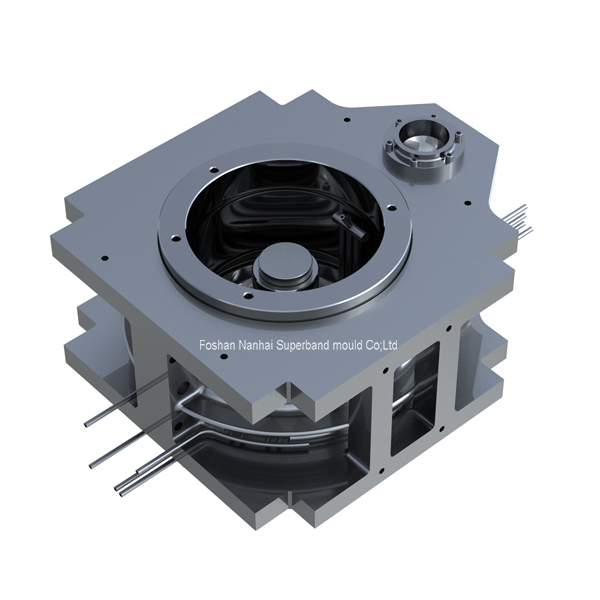
In Counter Pressure Casting (CPC), chamber pressure plays a vital role in shaping casting quality. The process uses two chambers: one holds the molten metal, the other the mold. By adjusting pressure in these chambers, we control how metal flows and solidifies. Increasing pressure in the furnace chamber while reducing it in the mold chamber creates a smooth, steady flow of molten metal. This balance prevents turbulence, which often causes defects like porosity or gas entrapment. Higher chamber pressure during solidification also compensates for metal shrinkage, reducing voids and improving density. Studies show that even small changes in chamber pressure can affect filling time and defect formation, making precise pressure control essential for consistent quality.
Temperature management is another key parameter. The molten metal's temperature must be carefully controlled to ensure uniform filling and solidification. Uneven temperature distribution causes hot spots or premature solidification, leading to defects such as cold shuts or incomplete filling. CPC benefits from controlled pressure, which helps maintain stable temperature gradients inside the mold. Cooling methods, like water or air cooling, are used to regulate temperature and solidification rates. Monitoring temperature at strategic points in the mold allows operators to optimize cooling and pressure settings, ensuring the metal solidifies uniformly. This leads to stronger castings with fewer internal stresses and better mechanical properties.
The combination of chamber pressure and temperature distribution directly impacts casting quality. Proper pressure prevents gas bubbles and shrinkage cavities, while uniform temperature ensures consistent microstructure and mechanical strength. Controlled solidification under pressure produces dense, defect-free castings with improved surface finish and dimensional accuracy. This is especially important for complex automotive parts where reliability and precision are critical. Experimental results confirm that optimizing these parameters reduces rework and scrap rates, lowering production costs. Manufacturers using CPC can achieve higher quality standards, meeting stringent industry requirements for safety and performance.
Experimental studies on Counter Pressure Casting (CPC) provide valuable data about how process variables influence casting quality. Researchers often compare different chamber pressure setups, such as standard pressure (CPC-SP) versus lower pressure (CPC-LP). These comparisons show that increasing chamber pressure reduces filling time and improves the uniformity of molten metal flow. This helps minimize defects like porosity and shrinkage cavities. Studies also reveal that maintaining pressure during solidification enhances metal density and mechanical strength. These insights confirm CPC’s ability to produce superior castings compared to traditional methods.
Microstructure examination of CPC castings highlights the benefits of controlled pressure and temperature during the process. Samples taken from cast parts show finer grain structures and fewer gas inclusions. The steady, laminar metal flow prevents oxide film formation, which otherwise causes weak spots. Controlled solidification under pressure encourages uniform grain growth and reduces micro-porosity. This results in castings with improved toughness and fatigue resistance. For example, aluminum parts produced by CPC often display more homogeneous microstructures, which directly correlate to better performance in demanding applications.
Mechanical tests on CPC-produced castings consistently demonstrate enhanced strength, ductility, and hardness. Tensile and fatigue tests reveal that parts made using CPC withstand higher loads and last longer under cyclic stresses. The reduction of internal defects, such as voids and shrinkage porosity, contributes to these improvements. Hardness tests also show more consistent values throughout the casting, indicating uniform material properties. These mechanical advantages make CPC castings particularly suitable for automotive components, where safety and durability are critical.
Finite Element Method (FEM) models play a crucial role in understanding and optimizing Counter Pressure Casting (CPC). These models simulate the entire casting process, including molten metal flow, pressure distribution, heat transfer, and solidification. By breaking down the mold and metal domain into small elements, FEM captures the complex interactions during filling and cooling stages. This detailed approach helps predict potential defects like porosity or cold shuts before actual production. Engineers use FEM to test different pressure profiles, mold designs, and cooling strategies virtually, saving time and cost. For example, adjusting chamber pressures in the model can show how metal flow changes, allowing fine-tuning to reduce turbulence and improve casting quality.
Using computational models, manufacturers gain predictive insights that guide process optimization. By simulating various scenarios, they identify the best combination of parameters such as furnace pressure, mold pressure, and temperature gradients. This helps maintain a smooth, laminar flow of molten metal and uniform solidification. Optimization reduces trial-and-error cycles in production, leading to fewer defects and higher yields. For instance, models can predict how increasing furnace chamber pressure affects filling time and shrinkage behavior. Such analysis supports decisions on pressure ramp rates or cooling methods, ensuring castings meet mechanical and dimensional requirements consistently.
Validation of computational models is essential to ensure their predictions match real-world outcomes. Experimental data from temperature sensors, pressure gauges, and casting inspections validate FEM simulations. Comparing predicted temperature distributions, solidification times, and defect locations with actual castings confirms model reliability. Continuous refinement based on experimental feedback improves accuracy. This iterative process builds confidence in using computational tools for process control and design improvements. Accurate models enable manufacturers to predict casting performance under various conditions, enhancing quality control and reducing scrap rates.
Counter Pressure Casting (CPC) is a refined casting method that enhances quality by controlling pressure during metal flow and solidification. It minimizes defects like porosity, improves mechanical properties, and suits complex geometries. Future prospects for CPC include broader applications in automotive and aerospace industries, driven by its efficiency and reliability. As a leading provider, Superband Mould offers innovative CPC solutions, ensuring high-performance parts that meet stringent industry standards, providing unmatched value to manufacturers seeking excellence.
A: Counter pressure casting is a specialized die casting process that uses controlled pressure in both the furnace and mold chambers to ensure smooth molten metal flow, reducing defects like porosity and shrinkage.
A: Counter pressure casting enhances aluminum control arm production by minimizing porosity and shrinkage, resulting in stronger, lightweight components that improve vehicle handling and fuel efficiency.
A: A counter pressure mold is crucial for preventing gas entrapment and ensuring laminar metal flow, which leads to higher quality castings with fewer defects compared to traditional methods.
A: Counter pressure casting provides aluminum subframes with dense, defect-free castings that withstand stress, enhance dimensional accuracy, and improve vehicle safety.
A: Unlike traditional die casting, counter pressure casting uses balanced pressure to prevent turbulence and gas entrapment, resulting in castings with superior mechanical properties and fewer defects.


